
Chinese Names with Meanings: How Names Work
Chinese names with meanings can express family history, personal values and hopes for the future. A Chinese name usually places the family surname first. The given name comes after it.

For example, look at 李明轩 (Lǐ Míngxuān):
- 李 (Lǐ) is the surname.
- 明轩 (Míngxuān) is the given name.
- 明 (Míng) means bright.
- 轩 (Xuān) can suggest a refined or distinguished person.
Chinese families may choose characters linked to wisdom, peace, courage, health, beauty, good luck or success. The sound also matters. Tones and character combinations can change how a name feels.
This guide covers the structure of Chinese names, common Chinese surnames and the meanings of Chinese given names. It also includes Chinese boy names, Chinese girl names and gender-neutral examples.
Quick Answer: How Do Chinese Names Work?
A Chinese name usually follows this order:
surname + given name
For example:
王伟 (Wáng Wěi)
- 王 (Wáng) is the surname.
- 伟 (Wěi) is the given name.
- The literal meaning of 伟 (Wěi) is great or remarkable.
Most Chinese surnames contain one character. A given name usually contains one or two characters. Most full Chinese names therefore have two or three characters.
Compound surnames also exist. Examples include:
- 欧阳 (Ōuyáng)
- 司马 (Sīmǎ)
- 上官 (Shàngguān)
These two-character surnames are much less common.
Chinese Names with Meanings: Structure and Name Order
A surname passes from one generation to the next, while a given name identifies an individual. A traditional Chinese name has two main parts:
- 姓 (Xìng): the surname or family name
- 名 (Míng): the given name
The Surname Comes First
In traditional Chinese name order, the family name appears before the given name.
A Chinese surname:
- Comes first
- Contains one character
- Shows family identity
- Connects a person with a wider family group
For example, in 李明轩 (Lǐ Míngxuān):
- 李 (Lǐ) is the surname.
- 明轩 (Míngxuān) is the given name.
The two characters in 明轩 (Míngxuān) form one complete given name. They do not work as a Western first name and middle name.
Some Chinese people reverse the order when writing in English. A person named 李明轩 (Lǐ Míngxuān) may write the name as Mingxuan Li in the United States or another English-speaking country.
Follow the name order that the person uses.
Single-Character and Two-Character Given Names
A Chinese given name:
- Comes after the surname
- Contains one or two characters
- Shows personal identity
- Expresses family hopes or personal qualities
A single-character given name contains one Chinese character. Examples include:
- 王伟 (Wáng Wěi)
- 李娜 (Lǐ Nà)
A two-character given name combines two Chinese characters. Examples include:
- 李明轩 (Lǐ Míngxuān)
- 王浩然 (Wáng Hàorán)
Choosing two characters allows families to combine different ideas and meanings. For example:
- 安然 (Ānrán) suggests peace and calm.
- 志远 (Zhìyuǎn) suggests far-reaching goals.
- 欣怡 (Xīnyí) suggests joy and contentment.
Generation Names
Some Chinese families share one character among relatives from the same generation.
For example:
- 李祖阳 (Lǐ Zǔyáng)
- 李祖丽 (Lǐ Zǔlì)
Both names use 祖 (Zǔ) as a generation character.
Not every family follows this custom today. However, some family records and naming traditions still use it.
Why Pinyin and Tones Matter
Pinyin shows how to pronounce Chinese characters in Mandarin. Tone marks matter because the same syllable can represent different Chinese characters.
For example:
- 王 (Wáng) means king and uses the second tone.
- 网 (Wǎng) means net and uses the third tone.
- 望 (Wàng) can mean hope or look toward and uses the fourth tone.
Chinese language guides should show both the characters and tone-marked Pinyin. Students can also read ApplyForChina’s guide to HSK levels and Chinese language learning
Chinese Surnames | Chinese Names List with Meanings
Chinese surnames can preserve links to ancient Chinese states, royal families, places, jobs and family groups.
Most are one-character surnames. Compound surnames such as 欧阳 (Ōuyáng) are less common.
China has thousands of family names. However, a small group of popular Chinese surnames covers a large share of the population.
The ten most common surnames represented about 42.7% of mainland China’s population in registered-population data published in 2018.
Ten Popular Chinese Surnames
| Rank | Chinese surname | Approximate population share |
| 1 | 王 (Wáng) | 7.27% |
| 2 | 李 (Lǐ) | 7.23% |
| 3 | 张 (Zhāng) | 6.84% |
| 4 | 刘 (Liú) | 5.17% |
| 5 | 陈 (Chén) | 4.54% |
| 6 | 杨 (Yáng) | 3.31% |
| 7 | 黄 (Huáng) | 2.42% |
| 8 | 赵 (Zhào) | 2.05% |
| 9 | 吴 (Wú) | 1.99% |
| 10 | 周 (Zhōu) | 1.92% |
These figures come from a 2018 dataset. They are historical estimates rather than current population totals. Ministry of Public Security reporting identified 王 (Wáng), 李 (Lǐ) and 张 (Zhāng) as the three leading surnames in that period.
1. 王 (Wáng)
Literal meaning: king or ruler
The character 王 (Wáng) means “king” or “ruler.” The surname has several historical roots. Many origin stories connect it with descendants of royal or princely families.
This history links the surname with China’s ruling houses. People may also associate it with leadership, dignity and authority. These ideas are cultural readings rather than fixed meanings of the surname.
Notable people with this surname include:
- 王羲之 (Wáng Xīzhī), a famous calligrapher
- 王贞仪 (Wáng Zhēnyí), an astronomer and mathematician
- 王一博 (Wáng Yībó), an actor and singer
2. 李 (Lǐ)
Literal meaning: plum
The character 李 (Lǐ) means “plum” or “plum tree.” Plum blossoms bloom during cold weather. They often represent strength, endurance and renewal in Chinese culture.
These ideas come from the plum blossom rather than the historical origin of the surname. The surname also gained importance as the family name of the Tang dynasty’s royal house.
Notable people with this surname include:
- 李白 (Lǐ Bái), a Tang-dynasty poet
- 李世民 (Lǐ Shìmín), the second Tang emperor
- 李娜 (Lǐ Nà), a tennis champion
3. 张 (Zhāng)
Literal meaning: to stretch, open or draw a bow
The early meaning of 张 (Zhāng) referred to placing a string on a bow or drawing a bow. The character later gained wider meanings, including “to stretch,” “to open” and “to expand.”
Traditional surname accounts also connect 张 (Zhāng) with bow-making. People may link the character with strength, readiness and precision. These are cultural readings, not fixed meanings of the surname.
Notable people with this surname include:
- 张艺谋 (Zhāng Yìmóu), a film director
- 张继科 (Zhāng Jìkē), an Olympic table tennis player
- 张学友 (Zhāng Xuéyǒu), a singer and actor
4. 刘 (Liú)
Historical character meaning: an axe-like weapon
Historical dictionaries give several meanings for 刘 (Liú). One refers to an axe-like weapon. Another means “to kill.”
These old meanings do not suggest that every family with the surname has a warrior background.
Notable people with this surname include:
- 刘亦菲 (Liú Yìfēi), an actress
- 刘翔 (Liú Xiáng), an Olympic hurdler
- 刘德华 (Liú Déhuá), an actor and singer
5. 陈 (Chén)
Literal meaning: to display, arrange or state
The character 陈 (Chén) can mean “to display,” “to arrange” or “to explain.”
The ancient 陈国 (Chén Guó), or State of Chen, also used this character. Many families later adopted the state’s name as their surname.
Chen, written 陈 (Chén), therefore has both a character meaning and a historical place-name origin.
Notable people with this surname include:
- 陈凯歌 (Chén Kǎigē), a film director
- 陈道明 (Chén Dàomíng), an actor
- 陈奕迅 (Chén Yìxùn), a singer
6. 杨 (Yáng)
Literal meaning: poplar tree
The character 杨 (Yáng) refers to a poplar tree. Poplars often grow tall and straight. Modern symbolic descriptions may therefore connect the character with growth, strength and steadiness.
These qualities describe the tree. They do not explain the history of every 杨 (Yáng) family.
The surname has several roots linked to old lands, family groups and noble lines.
Notable people with this surname include:
- 杨利伟 (Yáng Lìwěi), the first Chinese astronaut to travel into space
- 杨幂 (Yáng Mì), an actress
- 杨紫 (Yáng Zǐ), an actress
7. 黄 (Huáng)
Literal meaning: yellow
The character 黄 (Huáng) means “yellow.” Traditional Chinese thought linked yellow with the earth and the centre. Some periods of Chinese history also connected the colour with imperial culture.
However, the surname does not automatically show royal or noble ancestry.
黄 (Huáng) has several historical roots linked to ancient lands and family groups.
Notable people with this surname include:
- 黄渤 (Huáng Bó), an actor
- 黄晓明 (Huáng Xiǎomíng), an actor and singer
- 黄子韬 (Huáng Zǐtāo), a singer and actor
8. 赵 (Zhào)
Historical origin: the place called Zhao
A major origin story traces 赵 (Zhào) to 造父 (Zàofù).
According to traditional records, 周穆王 (Zhōu Mùwáng) rewarded him with land at 赵城 (Zhào Chéng). His descendants then adopted 赵 (Zhào) as their family name.
The State of Zhao later made the surname more widely known.
赵 (Zhào) also appears first in 百家姓 (Bǎijiāxìng), or Hundred Family Surnames.
Notable people with this surname include:
- 赵孟頫 (Zhào Mèngfǔ), a painter and calligrapher
- 赵丽颖 (Zhào Lìyǐng), an actress
- 赵露思 (Zhào Lùsī), an actress
9. 吴 (Wú)
Historical origin: the ancient State of Wu
One major origin of 吴 (Wú) comes from the ancient 吴国 (Wú Guó), or State of Wu.
After the state fell, some members of its ruling family and population adopted the state’s name as their surname.
Other 吴 (Wú) family lines came from different sources. The State of Wu is therefore one major origin, not the only one.
Notable people with this surname include:
- 吴承恩 (Wú Chéng’ēn), the writer traditionally linked to Journey to the West
- 吴京 (Wú Jīng), an actor and director
- 吴磊 (Wú Lěi), an actor
10. 周 (Zhōu)
Literal meaning: surrounding, complete or cycle
The character 周 (Zhōu) can mean “surrounding,” “complete” or “a cycle.”
The 周朝 (Zhōu Cháo), or Zhou dynasty, also used the same character.
The surname has several historical roots. One major tradition links it with people from the Zhou dynasty who later adopted 周 (Zhōu) as their surname.
People may connect the character with unity or a lasting family history. These are cultural readings rather than its only historical meaning.
Notable people with this surname include:
- 周杰伦 (Zhōu Jiélún), also known as Jay Chou
- 周迅 (Zhōu Xùn), an actress
- 周恩来 (Zhōu Ēnlái), a Chinese statesman
More Common Chinese Surnames and Bǎijiāxìng
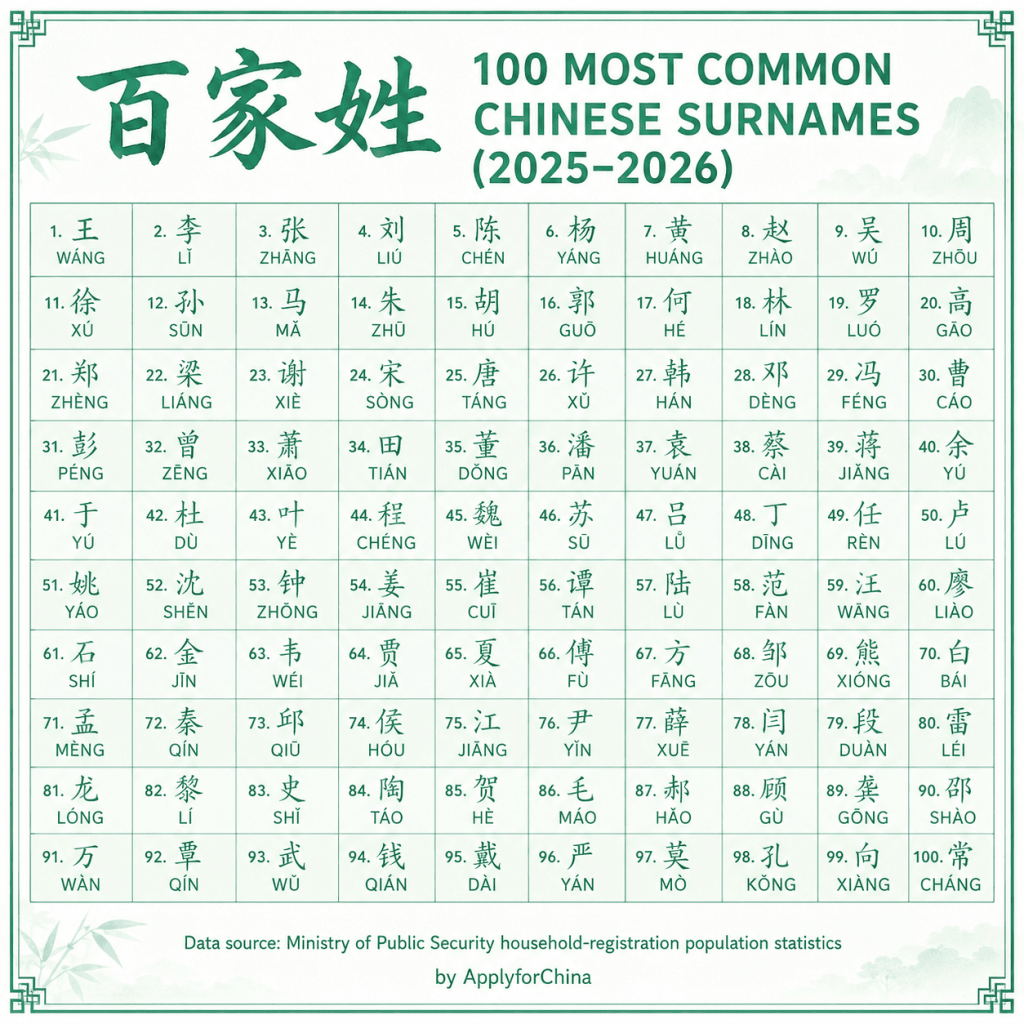
Many common Chinese surnames fall outside the top ten. Examples include 徐 (Xú), 孙 (Sūn), 马 (Mǎ), 朱 (Zhū) and 胡 (Hú). Others include 郭 (Guō), 何 (Hé), 林 (Lín), 罗 (Luó) and 高 (Gāo).
Many also appear in 百家姓 (Bǎijiāxìng), or Hundred Family Surnames. This classic Chinese text helped children learn surnames and characters. The infographic below shows a modern ranking of the 100 most common Chinese surnames.
Where Chinese Surnames Come From
The origins of Chinese surnames did not develop at random. Chinese family names grew through social and historical changes over thousands of years.
Most surname origins fit into five broad groups.

Ancient States and Kingdoms
Some families adopted the name of an ancient state.
Examples include:
- 陈 (Chén) from the State of Chen
- 宋 (Sòng) from the State of Song
- 郑 (Zhèng) from the State of Zheng
- 魏 (Wèi) from the State of Wei
- 韩 (Hán) from the State of Han
- 秦 (Qín) from the State of Qin
When a state fell, some residents kept its name. This preserved part of their family or regional identity.
Royal and Dynastic Families
Some surnames became well known through royal families.
Examples include:
- 李 (Lǐ) and the Tang dynasty
- 刘 (Liú) and the Han dynasty
- 王 (Wáng) and royal family lines
A royal link does not mean that every modern family member descends from the same emperor.
Places and Nature
Some surnames use Chinese characters linked to places or nature:
- 林 (Lín) — forest
- 江 (Jiāng) — river
- 田 (Tián) — field
- 石 (Shí) — stone
Jobs and Social Roles
Some surnames may have started from a job, title or official role:
- 马 (Mǎ) — horse
- 傅 (Fù) — tutor
- 钱 (Qián) — money
- 曹 (Cáo) — an old office or work group
Personal Traits and Symbols
Other surnames use characters linked to colours, animals or personal traits:
- 高 (Gāo) — high or tall
- 白 (Bái) — white
- 朱 (Zhū) — red or vermilion
- 龙 (Lóng) — dragon
The modern meaning of a surname may not show its full history. One surname can also have several origins.
Common Chinese Given Names and Their Meanings
Naming trends change over time. A name common among older Chinese people may not be popular for babies today.
Some widely used single-character given names include:
- 伟 (Wěi): great or remarkable
- 静 (Jìng): calm or quiet
- 敏 (Mǐn): clever or quick-minded
- 芳 (Fāng): fragrant or virtuous
- 娜 (Nà): graceful or elegant
Modern Chinese names often use two characters. 奕辰 (Yìchén) is one example found in recent name lists.
Some Chinese families also ask older family members or fortune tellers for advice. They may consider birth dates, the Five Elements, or the number of strokes in each character.
Not every family follows these customs.
What Do Chinese Names with Meanings Express?
Chinese name meanings often express a hope, image or valued quality.
Wisdom and Learning
Families may choose:
- 明 (Míng) — bright or intelligent
- 慧 (Huì) — wise
- 博 (Bó) — learned
- 文 (Wén) — culture or literature
For example, 文博 (Wénbó) can suggest broad learning.
Peace, Health and Good Luck
Families may choose:
- 安 (Ān) — peace
- 康 (Kāng) — health
- 乐 (Lè) — joy
- 宁 (Níng) — calm
- 福 (Fú) — good fortune
For example, 嘉宁 (Jiāníng) can suggest goodness and peace.
Nature
Nature-based characters include:
- 雨 (Yǔ) — rain
- 晨 (Chén) — morning
- 海 (Hǎi) — sea
- 雪 (Xuě) — snow
- 月 (Yuè) — moon
For example, 晨曦 (Chénxī) means morning light.
Strength and Ambition
Families may choose:
- 志 (Zhì) — ambition
- 强 (Qiáng) — strong
- 伟 (Wěi) — great
- 勇 (Yǒng) — brave
- 远 (Yuǎn) — far-reaching
For example, 志远 (Zhìyuǎn) suggests long-term ambition.
Chinese Names with Meanings for Boys and Men
The Chinese names for boys below are complete given names, not single naming characters.
- 浩然 (Hàorán): broad and upright
- 宇轩 (Yǔxuān): refined and broad-minded
- 文博 (Wénbó): cultured and learned
- 志远 (Zhìyuǎn): far-reaching ambition
- 俊杰 (Jùnjié): talented and outstanding
These Chinese boy names may also suit readers looking for Chinese names for men. However, naming styles can vary by age and generation.
A separate guide can provide a much longer list of Chinese boy names with meanings.
Chinese Girl Names and Female Names with Meanings
The following Chinese girl names combine characters linked to joy, calmness, wisdom and nature:
- 雅静 (Yǎjìng): elegant and calm
- 欣怡 (Xīnyí): joyful and content
- 雨桐 (Yǔtóng): rain and parasol tree
- 慧敏 (Huìmǐn): wise and quick-minded
- 婉清 (Wǎnqīng): gentle and clear
These examples may also help readers searching for Chinese names for female students or family members.
A separate guide can provide more Chinese female names and explain which choices sound traditional or modern.
Gender-Neutral Chinese Names with Meanings
Many Chinese characters are gender neutral. The full name and current naming trends can shape how Chinese people understand it.
Examples include:
- 安然 (Ānrán): peaceful and calm
- 晨曦 (Chénxī): morning light
- 嘉宁 (Jiāníng): good and peaceful
- 明宇 (Míngyǔ): bright and broad-minded
- 思远 (Sīyuǎn): thoughtful and far-sighted
Can International Students Choose a Chinese Name?
Yes. Many international students choose a Chinese name for Mandarin classes and daily life.
You can choose a name in two main ways:
- Select Chinese characters that sound like your original name.
- Select characters based on meanings that matter to you.
When choosing a Chinese name, check that it:
- Sounds natural in Mandarin
- Uses characters that work well together
- Avoids negative or funny sound-alikes
- Matches the image you want
- Has been checked by a Chinese speaker
Do not place your Chinese name on official documents unless a university or government office asks for it.
Students can compare Chinese language programs in China or read the guide to studying Chinese language in China.
Learn More About Chinese Language and Culture
Learning how Chinese names work can improve your character knowledge and make introductions easier.
ApplyForChina helps international students compare universities, language courses and degree programs. Students who plan to study in China can explore available options and receive support with their applications.
Related Guides for International Students
- Best apps and websites for learning Chinese
- How the Chinese higher education system works
- How to apply to Chinese universities
- Study abroad in China guide for international students
FAQs About Chinese Names with Meanings
王 (Wáng) ranked first in China’s 2018 surname data. It covered about 7.27% of the mainland population in that report.
The surname normally comes first in Chinese name order. Some Chinese people reverse the order when writing in English.
Most full names contain two or three characters. Compound surnames can create four-character names.
Some names sound more masculine or feminine. Other names are gender neutral.
Each surname uses a character with a meaning. However, its literal meaning may not explain the surname’s full history.
Yes. Common Chinese surnames and popular given names create many repeated full names.
Yes, especially in Chinese language content. Write 王伟 (Wáng Wěi) rather than only Wang Wei.