
A Complete Guide to Dynasties in China
Chinese history is most commonly understood through dynasties. Ancient China traditionally organized history by ruling families. Dividing Chinese history by dynasties provides a structured way to understand politics and social change across east asia.
Understanding dynasties is essential because they provide:
- A chronological framework for over 4,000 years of history
- Political context for cultural development
- Explanations for shifts in power and governance
- Insight into the evolution of Chinese identity
Western history often emphasizes centuries or ideological eras, Chinese historiography centers on ruling houses and legitimacy.
This article explains all the chinese dynasties. We will discuss how dynastic rule shaped ancient Chinese culture and influenced Chinese people, political systems, and social order.
What is the difference between a dynasty and an empire in Chinese history?
In Chinese history, a dynasty refers to a ruling house that governs the Chinese government. Each dynasty establishes their own administrative systems, cultural norms, and long-term political systems.
An empire refers to the territorial and political structure under that dynasty. In many cases, one dynasty ruled one empire.
A key idea of dynastic rule is the Mandate of Heaven (天命), also known as the son of heaven concept. This means that rulers have divine approval to govern. However, natural disasters, rebellion, or civil unrest could signal that Heaven had withdrawn this approval.
“The Mandate of Heaven was a political doctrine used to justify the authority of the ruler and the right of rebellion against tyranny.”
— Encyclopaedia Britannica
Historians emphasize that dynasties are a framework, not a law of history.
“The dynastic cycle should be understood as ideology rather than an inevitable historical pattern.”
— James A. Millward, Cambridge University Press
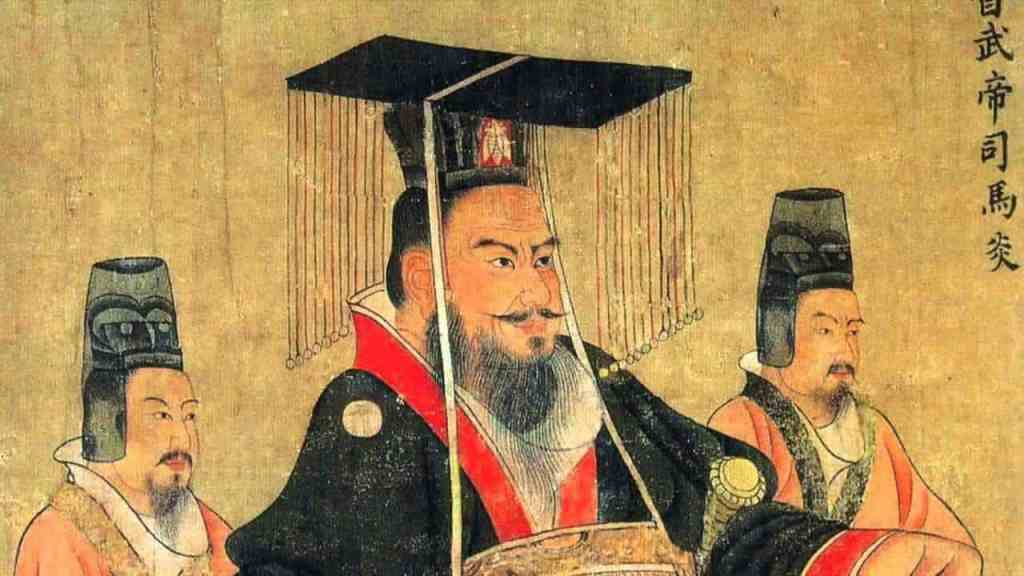
How the Dynastic Cycle Worked
Although modern historians debate its accuracy, traditional Chinese political thought described history as a cycle:
- A new dynasty gains the Mandate of Heaven
- The dynasty prospers and expands
- Corruption and inefficiency increase
- Natural disasters and rebellions occur
- The dynasty collapses
- A new ruling house claims legitimacy
This concept helped explain political change while maintaining moral order.
Timeline of Dynasties in Ancient China
China’s imperial history is commonly summarized into 13 major dynasties, with several important transitional periods shaped by civil war, reunification, and large-scale governance.
Early Dynasties
- Xia (c. 2070–1600 BCE)
- Shang (c. 1600–1046 BCE)
- Zhou (c. 1046–256 BCE)
Imperial China
- Qin (221–206 BCE)
- Han (206 BCE–220 CE)
- Six Dynasties Period (220–589)
- Sui (581–618)
- Tang (618–906)
- Five Dynasties and Ten Kingdoms (907–960)
- Song (960–1279)
- Yuan (1279–1368)
- Ming (1368–1644)
- Qing (1644–1911)
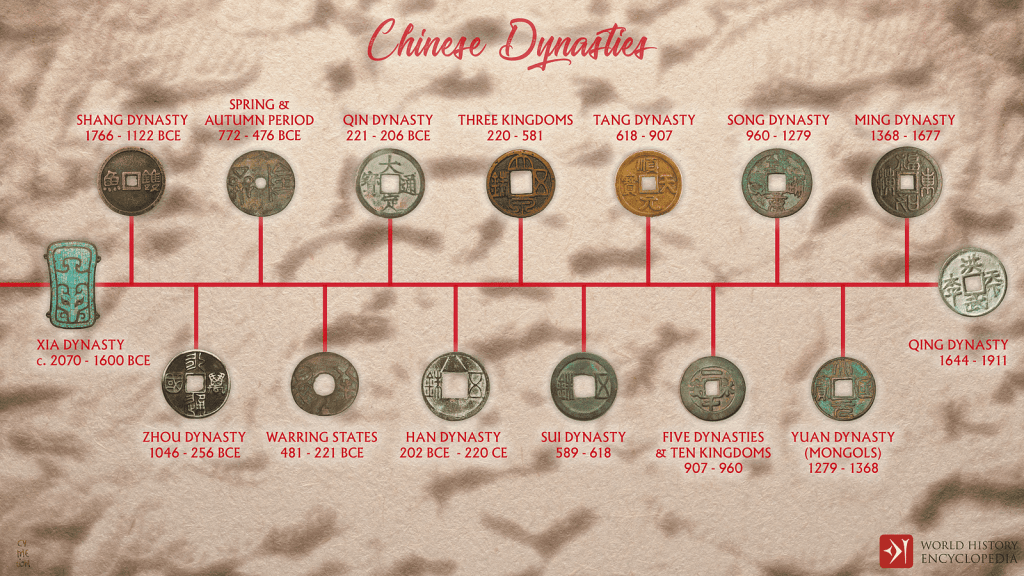
Chronological Overview
Capital cities reveal where political and economic power was concentrated during each dynasty.
- Shang capitals: near present-day Zhengzhou and Anyang
The late Shang capital at Anyang produced oracle bones, the earliest Chinese writing. This confirms a centralized court based in the Yellow River region. - Zhou capitals: Hao (near present-day Xi’an) and Luoyang
The Zhou moved east to Luoyang after the invasion. This shift weakened royal authority and led to regional competition during the Spring and Autumn and Warring States periods. - Qin capital: Chang’an (present-day Xi’an)
From Chang’an, the Qin unified China in 221 BCE and built the first centralized imperial system. - Han capitals: Chang’an (Western Han) and Luoyang (Eastern Han)
The move to Luoyang after political unrest reflects internal instability but continued imperial rule. - Tang capitals: Chang’an and Luoyang
Chang’an became one of the largest cities in the world and a major Silk Road hub, reflecting Tang strength and prosperity. - Song capitals: Bianjing (Kaifeng) and Hangzhou
After the northern invasion, the Song moved south to Hangzhou. This marks a shift toward southern economic dominance and maritime trade. - Yuan capital: Dadu (present-day Beijing)
The Mongol Yuan ruled from Dadu, strengthening northern political control and linking China to the wider Mongol Empire. - Ming capitals: Nanjing and Beijing
The Ming first ruled from Nanjing, then moved to Beijing to secure the northern frontier and reinforce imperial authority. - Qing capital: Beijing
The Qing retained Beijing while governing a vast, multiethnic empire until imperial rule ended in 1911.
Names of Chinese Dynasties — The major dynasties explained
Xia Dynasty (c. 2070–1600 BCE)
Traditionally considered the first Chinese dynasty. Historical evidence is limited, and many scholars regard it as legendary or semi-mythical.
Shang Dynasty (c. 1600–1046 BCE)
The earliest dynasty supported by strong archaeological evidence. Shang rulers developed:
- Early Chinese writing using oracle bones
- Bronze metallurgy
- Religious divination systems
- Early Chinese characters
“The Shang dynasty is the earliest Chinese dynasty for which there is documentary evidence.”
— Encyclopaedia Britannica
Zhou Dynasty (c. 1046–256 BCE)
Which dynasty lasted the longest?
The Zhou dynasty lasted the longest, ruling for nearly eight centuries. It introduced:
- The Mandate of Heaven
- Feudal governance
- Classical Chinese philosophy
- Early concepts of yin and yang
Confucius lived during the Eastern Zhou period, including the warring states period, shaping Chinese ethics for millennia.
Qin Dynasty (221–206 BCE)
Who unified China first?
Despite being short-lived, China was first unified under the Qin dynasty in 221 BCE.
- Writing
- Currency
- Weights and measures
“The Qin created a unitary state by imposing centralized administration.”
— Columbia University, Asia for Educators
Han Dynasty (206 BCE–220 CE)
Often described as a golden age. Major developments include:
- Civil service bureaucracy
- Silk Road expansion across east asia
- Paper and porcelain inventions
The term “Han Chinese” originates from this dynasty.
Six Dynasties Period (220–589)
A time of fragmentation following the Han collapse. Despite instability:
- Buddhism spread widely
- Southern Chinese culture developed rapidly
- Repeated civil war reshaped social order
Sui Dynasty (581–618)
A short reunification dynasty that:
- Completed the Grand Canal
- Expanded the great wall of china
- Centralized governance
Tang Dynasty (618–906)
Frequently called the peak of Chinese civilization.
- Cosmopolitan cities
- Poetry and fine arts flourished
- China became the world’s most populous empire
“The Tang period was one of cosmopolitanism and cultural flowering.”
— Columbia University
Five Dynasties and Ten Kingdoms (907–960)
A transitional era marked by political division but continued cultural innovation, including the spread of printing technology.
Song Dynasty (960–1279)
Known for:
- Economic growth
- Urbanization
- Gunpowder, compass, paper money
Despite innovation, the Song fell to Mongol invasion.
Yuan Dynasty (1279–1368)
Founded by the Mongols under Kublai Khan.
- First non-Han dynasty to rule all of China
- Capital established in Dadu (modern Beijing)
Ming Dynasty (1368–1644)
A period of strong centralized rule and cultural production.
- Completion of the great wall of china
- Construction of the Forbidden City
- Global trade via maritime routes
Qing Dynasty (1644–1911)
The last imperial dynasty.
- Territorial expansion
- Population growth
- Decline under foreign pressure and internal unrest
The abdication of Emperor Puyi ended over two thousand years of imperial rule, ushering China into the 19th century transition toward modern Chinese history.
Ancient Chinese Dynasties and Culture
What was the culture of ancient China?
Ancient Chinese culture was shaped layer by layer as dynasties rose, ruled, and collapsed. Each dynasty added something new, yet rarely erased what came before. Over time, this created a deep sense of continuity across long history.
At the heart of ancient China was family. Lineage mattered.
People honored their ancestors with rituals, offerings, and remembrance. These practices reinforced social order and moral responsibility within families and the state.
From this structure grew a highly organized bureaucratic state. Rulers governed not only through force, but through educated officials trained in classical texts, moral reasoning, and administrative skill.
Culture was also expressed through writing and art:
- Poetry recorded emotion and political loyalty
- Calligraphy functioned as both communication and art
- Historical records preserved memory and legitimacy
Across centuries, massive large scale infrastructure projects reshaped daily life:
- Canals connected distant regions
- Roads and walls protected borders and trade
- Cities became administrative centers
Finally, ancient China was never isolated. Trade routes across east Asia and beyond brought new goods, ideas, and belief systems into Chinese society. Buddhism entered China through these exchanges and permanently shaped philosophy and art.

What is traditional Chinese culture?
Traditional Chinese culture reflects values that survived dynastic change and shaped Chinese people across centuries.
Education and hierarchy remained central. Learning was seen as a moral duty, not merely personal achievement.
Moral governance was equally important. Rulers were expected to lead by virtue, and people believed injustice could trigger natural disasters or rebellion.
Social harmony mattered deeply. Balance was considered the ideal state: between ruler and subject, parent and child, individual and society.
Finally, continuity through texts and ritual sustained tradition:
- Classical writings
- Seasonal festivals
- Ancestral ceremonies
These practices connected generations, allowing tradition to endure even as dynasties rose and fell.
Frequently Asked Questions
What are the main dynasties of China?
The main dynasties of China are commonly identified as the Xia, Shang, Zhou, Qin, Han, Sui, Tang, Song, Yuan, Ming, and Qing dynasties, along with important transitional periods such as the Six Dynasties period and the Five Dynasties and Ten Kingdoms period.
What is the timeline of Chinese history based on dynasties?
The timeline of Chinese history based on dynasties begins with the Xia dynasty in the early second millennium BCE and continues through successive ruling houses until the end of the Qing dynasty in 1911, marking the conclusion of imperial rule and the transition toward modern Chinese history.
What is the oldest dynasty in China?
The Xia dynasty appears first in traditional history, while the Shang dynasty is the earliest supported by archaeological evidence.
Does China have 5000 years of history?
China is often described as having 5,000 years of civilization, though clear dynastic records begin with the Shang dynasty.
How many dynasties were there in China?
Historians commonly identify 13 major dynasties, though the number varies depending on classification.
What are the 6 Chinese dynasties?
A common simplified list includes Xia, Shang, Zhou, Qin, Han, and Tang.
What are the 5 dynasties of China?
This usually refers to the Five Dynasties period (907–960), rather than a list of major dynasties.
What does “Dynasty” mean in Chinese culture?
It refers to a ruling family whose legitimacy was traditionally justified by the Mandate of Heaven.
What are 5 historical facts about ancient China?
- Dynasties structured historical chronology
- The Mandate of Heaven legitimized rule
- Bureaucracy shaped governance
- Trade routes connected China globally
- Cultural continuity persisted despite political change
Start Your Journey to Study in China Today
Choosing to study in China is a life-changing decision that opens the door to world-class education, cultural diversity, and exciting global opportunities. Whether you’re researching top China universities or preparing your China university application, having a trusted partner can make all the difference.
At ApplyForChina, we make the process simple and stress-free. From finding the right university to submitting your application, we’re here to support you every step of the way.