
Taiwan Mandarin vs Mainland Chinese: Key Differences
When discussing the differences between the languages speaking in Taiwan and Mainland China, it’s important to clarify that both regions share a common linguistic foundation but have developed distinct characteristics over time. Taiwan Province is located in the southern part of Mainland China, so Mandarin Chinese is the official language in both Taiwan and mainland China, the way it is spoken, written, and influenced by local cultures creates notable differences. Let’s dive into the key differences and explore some examples to make these distinctions clearer.
What Is Taiwan Language (Taiwanese mandarin)?
Taiwan’s linguistic environment is diverse and multifaceted. In truth, the primary language used in Taiwan is Mandarin Chinese, which serves as the official language and is used in education, media, and government. However, Taiwan is also home to other languages and dialects, including:
- Taiwanese Hokkien: Hokkien is a Southern Min (Min Nan 闽南) dialect spoken by about 70% of the population, which is often used in informal settings. This dialect also become one of the biggest influences in the Taiwan Language.
- Hakka: This is another dialect that is spoken by the Hakka ethnic group, making up about 15% of the population.
- Formosan Languages: This is an indigenous language spoken by Taiwan’s Aboriginal peoples, although many are endangered.
- English: Surprisingly, English has been increasingly used as a second language, especially among younger generations.
As mentioned before, the Taiwan Language (Taiwanese Dialect) has been influenced by other dialects and languages, primarily Hokkien and Japanese. Taiwan was influenced by the Hokkien dialect because the majority of the population used it. On the other hand, Japanese influence can be traced back to the historical era when the island was occupied by the Japanese. This has resulted in some vocabulary being loanwords or showing similarities to Hokkien and Japanese. For example, the phrase “很瞎 (hěn xiā)” (meaning “ridiculous” or “nonsensical”) comes from Hokkien.
What Is Mainland Chinese Mandarin?
In mainland China, Mandarin Chinese (officially known as 普通话 Putonghua) is the official language and is spoken by the majority of the population. While the languages of Taiwan are primarily influenced by Hokkien and Japanese, in mainland China, regional dialects such as Cantonese and Shanghainese have a greater impact. However, China is linguistically diverse, with hundreds of dialects and minority languages that differ in almost every city as:
- Cantonese: Widely spoken in Guangdong province and Hong Kong.
- Shanghainese: A Wu dialect spoken in Shanghai.
- Pekingese: A Mandarin Chinese dialect used in Beijing and nearby regions, which serves as the phonological foundation for Standard Chinese (Putonghua).
- Other Dialects: Hokkien, Hakka, and others are included, though these are less prevalent than in Taiwan.
- Minority Languages: Tibetan, Uyghur, and Mongolian are spoken by ethnic minority groups.
Taiwanese mandarin VS Mainland Chinese Mandarin
1. Chinese Characters and Written Script
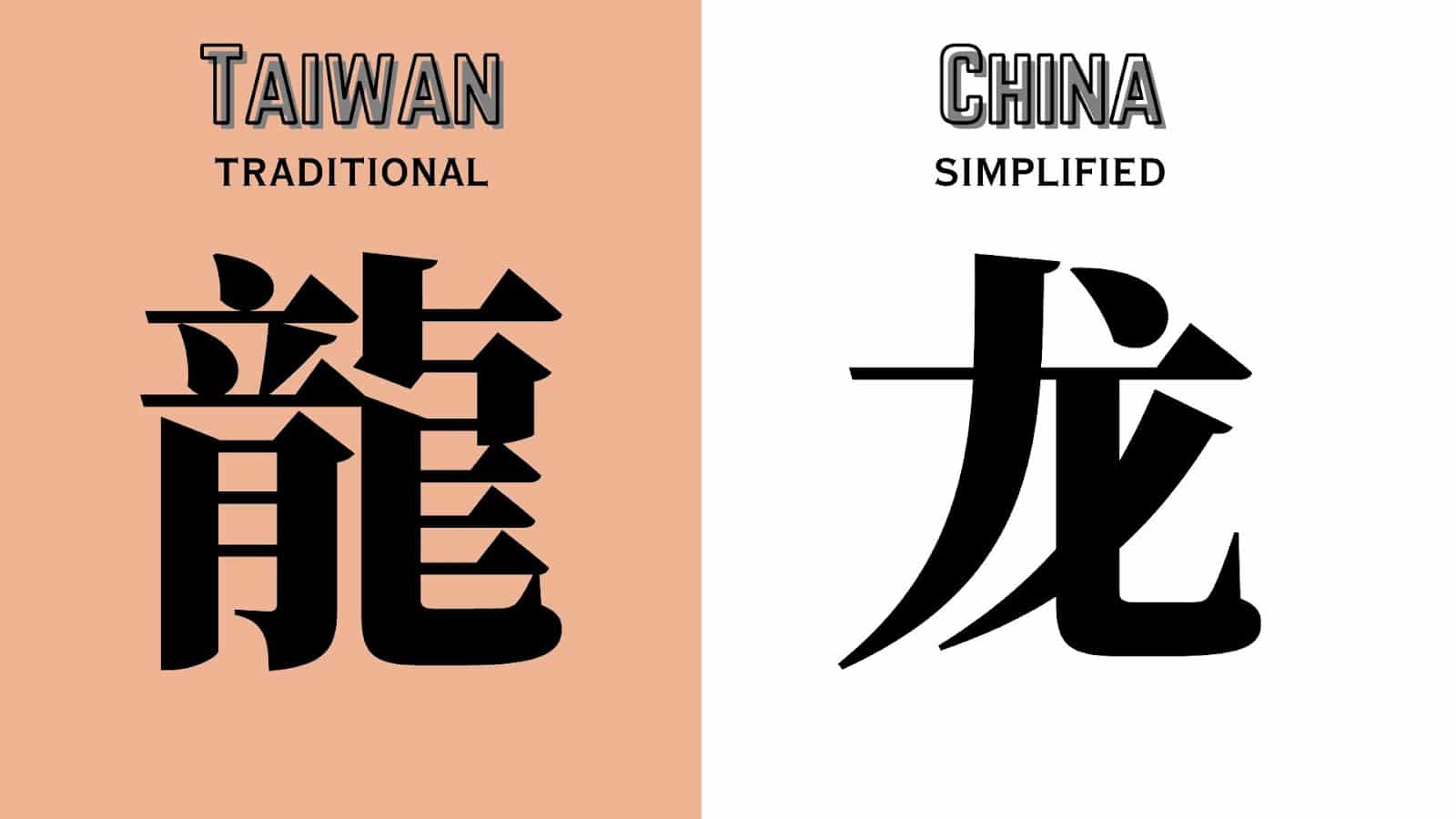
One of the striking differences between theTaiwanese mandarin and the Chinese language is the type of script they use. If you are unfamiliar with the term “script,” it refers to the font or type of Chinese characters, which are divided into traditional (繁体字 fán tǐ zì) and simplified characters (简体字 jiǎn tǐ zì). The Taiwanese language uses more complex traditional characters that retain the script’s historical form. China, on the other hand, has converted to using simplified characters. These were introduced in the 1950s to improve literacy rates by reducing the number of strokes in the characters.
Example:
| English | Taiwanese mandarin (traditional) | Mainland Chinese Mandarin (simplified) |
| Dragon | 龍 (lóng) | 龙 (lóng) |
| Love | 愛 (ài) | 爱 (ài) |
| Eat | 吃飯 (chī fàn) | 吃饭 (chī fàn) |
| Study | 學 (xuě) | 学 (xuě) |
| Time | 時間 (shí jiān) | 时间 (shí jiān) |
| Taxi | 計程車 (计程车 jì chéng chē) | 出租车 (chūzū chē) |
2. Pronounciation and Romanization
In addition to Chinese characters, Mandarin also employs a romanization system, which is the standard for transliterating Chinese. The Chinese and Taiwanese dialect utilize different systems. While the Chinese use 拼音 (Pīnyīn) as their standard, Taiwan employs both Pinyin and phonetic symbols. Furthermore, since Chinese and Taiwanese languages are tone-based, both Pinyin and the phonetic symbols include additional ‘tone’ markings to indicate which tones the words should be pronounced in.
So, what are these phonetic symbols? Phonetic symbols have many other names, such as Bopomofo, Zhuyin Fuhao (注音符號; 注音符号; Zhùyīn fúhào), or simply Zhuyin. The name Bopomofo actually comes from the first four letters of the alphabet: “b, p, m, f” (ㄅㄆㄇㄈ), which are pronounced as “bo, po, mo, fo.” Zhuyin consists of 37 characters, each representing either a consonant or a vowel. Today, Bopomofo is more commonly used in Taiwan than on the mainland and serves as the primary electronic input method for typing.

3. Pronunciation and Accent
While both regions speak Mandarin, their accents and pronunciations differ slightly. Taiwanese Mandarin is influenced by Taiwanese Hokkien and Japanese, resulting in softer tones and some unique vocabulary. In contrast, the Chinese Language is considered the standard, and the Beijing dialect particularly has a more pronounced “erhua” (儿化) feature, where the “r” sound is added to the end of words.
Example:
| English | Taiwanese mandarin (traditional) | Mainland Chinese Mandarin (simplified) |
| Glasses/spectacle | 眼鏡 (yǎn jìng) | 眼镜儿(yǎn jìng’er) |
| Instant noodles | 速食面 (sùshímiàn) | 方便面 (fāngbiànmiàn) |
| Kindergarten | 幼稚园 (yòushìyuán) | 幼儿园 (yòu’éryuán) |
| Square meters | 坪 (píng) | 平方米 (píngfāng mǐ) |
4. Vocabulary and Terminology
Due to political and cultural differences, some words and phrases have diverged. Taiwan often retains older terms or uses loanwords from Japanese and English, while mainland China has adopted new terms or uses different translations. Therefore, sometimes, the words used might be entirely different.
Example:
| English | Taiwanese mandarin (traditional) | Mainland Chinese Mandarin (simplified) |
| Bicycle | 腳踏車 (脚踏车 jiǎo tà chē) | 自行车 (zì xíng chē) |
| Software | 軟體 (软体 ruǎn tǐ) | 软件 (ruǎn jiàn) |
| Lunch box | 便當 (便当 biàn dāng) *Notes: taken from the Japanese 弁当 (べんとう bento) | 盒饭 (hé fàn) |
| Pineapple | 鳳梨 (凤梨 fèng lí) | 菠萝 (bō luó) |
| Cheese | 起司 (qǐ sī)*Notes: taken from the English word | 奶酪 (nǎi lào) |