What is the Difference between Chinese vs Japanese?
Chinese and Japanese may look similar because Japanese uses kanji from Chinese characters. But they are different languages with different sounds, grammar, writing systems, and cultural styles. Chinese is often harder for pronunciation because of tones. Yet, Japanese is often harder for grammar, particles, and mixed writing.
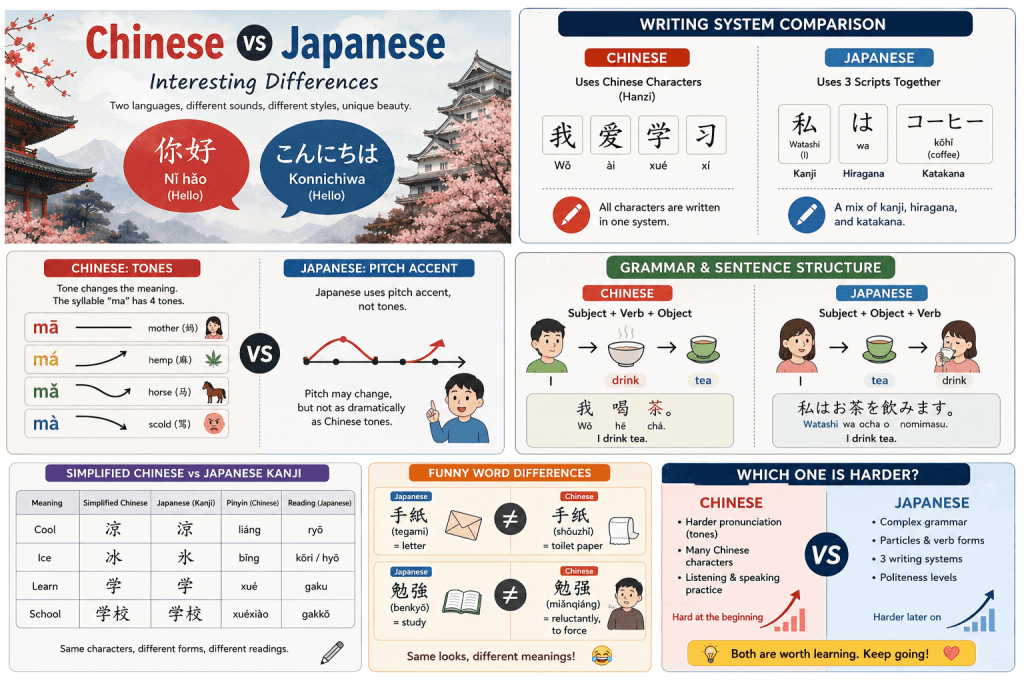
Chinese vs Japanese language interesting differences are easy to see once you compare how both languages sound, write, and build sentences. The Chinese language uses tones and Chinese characters, while Japanese uses kanji, hiragana, and katakana in one writing system.
Both languages are useful and beautiful. But they challenge learners in different ways.
If you want to study in China, learn Chinese, or understand East Asian culture, this guide will help you compare Chinese and Japanese in a simple way.
- What is the Difference between Chinese vs Japanese?
- What are the main differences between Chinese and Japanese?
- Kanji vs Chinese: Why do Chinese and Japanese look similar?
- How is Chinese pronunciation different from Japanese pronunciation?
- How are Chinese and Japanese grammar different?
- Is Chinese or Japanese harder to learn?
- How are Chinese and Japanese expressions different?
- Funny word differences between Chinese and Japanese?
- Can Chinese speakers understand Japanese?
- Can Japanese speakers understand Chinese?
- Should you learn Chinese or Japanese first?
- Why is learning Chinese useful for students?
- Final answer: Chinese language vs Japanese language
- Related Articles
- Frequently Asked Questions
- Start Your Journey to Study in China Today
What are the main differences between Chinese and Japanese?
Chinese and Japanese are not the same language.
They share some written characters because Japan borrowed Chinese characters long ago. In Japanese, these borrowed characters are called kanji. In Chinese, they are called hanzi.
| Comparison | Chinese | Japanese |
| Pronunciation | Uses tones | Uses pitch accent (not Mandarin-style tones) |
| Grammar Style | Usually more direct | Uses particles and verb changes |
| Writing System | Mainly uses Chinese characters | Uses kanji, hiragana, and katakana |
| Sentence Structure | Subject-Verb-Object (SVO) | Subject-Object-Verb (SOV) |
So, even if Chinese and Japanese look similar sometimes, they are very different in real use.
Kanji vs Chinese: Why do Chinese and Japanese look similar?
Chinese and Japanese look similar because Japanese uses kanji, and kanji came from Chinese characters.
Some words look the same or almost the same in both languages.
For example:
- 便利 (biànlì / benri) means “convenient” in both Chinese and Japanese.
- 水 (shuǐ / mizu) means “water” in both Chinese and Japanese.
- 学校 (xuéxiào / gakkō) means “school” in both Chinese and Japanese.
But the pronunciation is different.
In the Chinese language, 便利 is read as biànlì. In Japanese, it is read as benri.
This is one of the most important Chinese vs Japanese language interesting differences. The written form may look familiar, but the spoken form can sound completely different.
How are Chinese characters and Japanese characters different?

Chinese mainly uses Chinese characters, also called hanzi.
Japanese uses three scripts in one writing system:
- Kanji: Chinese-based characters used for many nouns, verbs, and ideas.
- Hiragana: A phonetic script used for grammar, particles, and native Japanese words.
- Katakana: A phonetic script used for foreign words, names, and emphasis.
For example, a Japanese sentence can mix all three scripts:
私はコーヒーを飲みます。 (Watashi wa kōhī o nomimasu.) This means: “I drink coffee.”
In this sentence:
- 私 (watashi) is kanji.
- は (wa), を (o), and 飲みます (nomimasu) use hiragana.
- コーヒー (kōhī) is katakana for “coffee.”
The Chinese writing system is more character-based. The Japanese writing system is more mixed.
This is why Chinese characters may feel hard at first, but Japanese writing can feel more complex later.
What is the difference between simplified Chinese and Japanese kanji?

Mainland China uses simplified Chinese characters for most modern writing.
Japan uses kanji. Some kanji forms look closer to older traditional Chinese characters. Some kanji also have Japanese-style simplified forms.
For example:
| Chinese | Japanese | Meaning |
| 凉 (liáng) | 涼 (ryō) | cool |
| 冰 (bīng) | 氷 (kōri) | ice |
Some characters look the same. Some look slightly different. Some have different meanings in each language.
So, learners should not assume every shared-looking character means the same thing.
How is Chinese pronunciation different from Japanese pronunciation?

Chinese pronunciation, especially Mandarin, depends heavily on tones.
A tone can change the meaning of a word.
For example:
- 妈 (mā) = mother
- 麻 (má) = hemp
- 马 (mǎ) = horse
- 骂 (mà) = scold
This makes the Chinese language difficult for many beginners.
Japanese people do not use tones in the same way. It uses pitch accent. Pitch can affect meaning, but it is usually less difficult for beginners than Mandarin tones.
For many learners:
- Chinese is harder to pronounce.
- Japanese is easier to pronounce at the start.
- Chinese tones need more listening practice.
- Japanese pitch accent becomes more important at higher levels.
If you want to learn Chinese well, tone practice is very important. Especially if you want to study in China, basic tones will help you speak more clearly in daily life.
How are Chinese and Japanese grammar different?
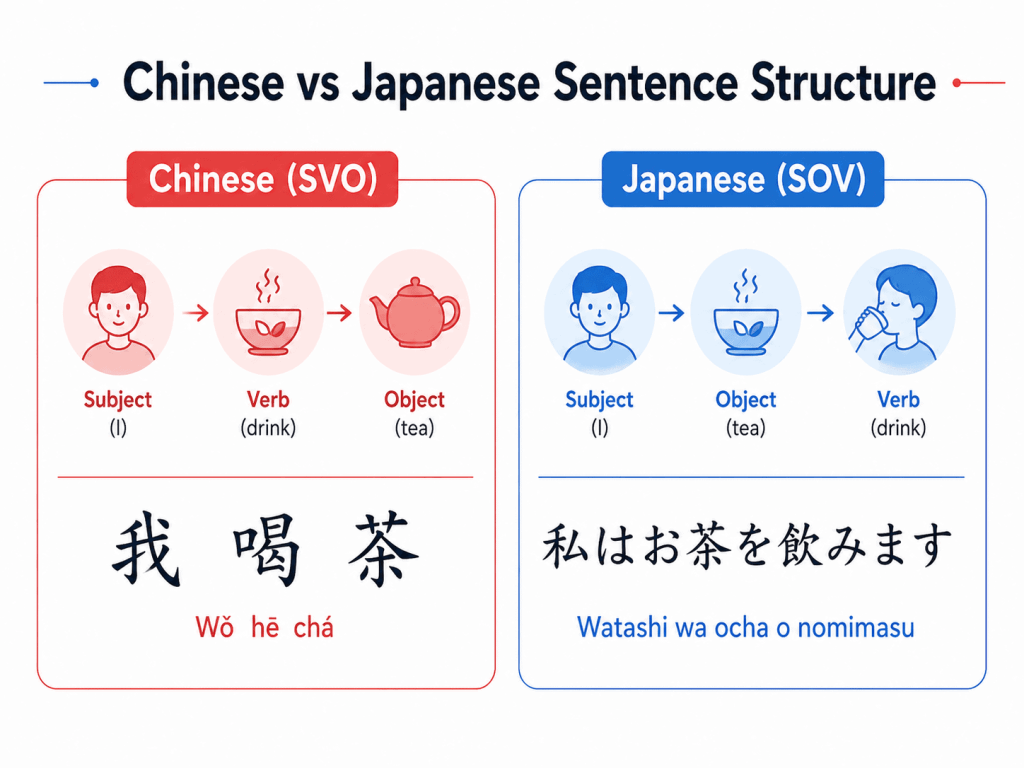
Chinese grammar is often more direct than Japanese grammar.
Mandarin Chinese usually follows this sentence order:
Subject + Verb + Object
For example:
我喝茶。 (Wǒ hē chá.) I drink tea.
Japanese usually follow this sentence order:
Subject + Object + Verb
For example:
私はお茶を飲みます。 (Watashi wa ocha o nomimasu.) I tea drink.
This word order feels very different for English speakers.
Chinese often feels simpler because verbs do not change much. Japanese feels more complex because verbs change based on tense, politeness, and sentence meaning.
Grammar & Structure: Which one is harder?
For grammar, Japanese is usually harder than Chinese for many English-speaking learners.
Chinese grammar has challenges, but it is often more straightforward. Verbs do not change for tense, person, or number.
For example, the Chinese verb 吃 (chī) means “eat.” It does not change like “eat,” “eats,” “ate,” or “eaten.”
Instead, Chinese uses time words or particles:
- 我吃饭。 (Wǒ chī fàn.) = I eat.
- 我昨天吃饭。 (Wǒ zuótiān chī fàn.) = I ate yesterday.
- 我吃了饭。 (Wǒ chī le fàn.) = I ate / I have eaten.
On another hand, Japanese grammar has more moving parts.
Japanese verbs change depending on:
- tense
- politeness
- negative form
- request form
- conditional meaning
- casual or formal speech
For example, the Japanese verb 食べる (taberu) means “to eat.”
It can change into:
- 食べます (tabemasu) = eat / will eat, polite
- 食べました (tabemashita) = ate, polite
- 食べない (tabenai) = do not eat, casual
- 食べません (tabemasen) = do not eat, polite
- 食べてください (tabete kudasai) = please eat
Japanese also uses particles like は (wa), が (ga), を (o), に (ni), and で (de). These small words show the role of each word in a sentence.
So, the basic answer is:
- Chinese grammar is easier for beginners.
- Japanese grammar is harder and more layered.
- Chinese pronunciation is harder because of tones.
- Japanese writing can feel harder because it uses three scripts.
This is one of the clearest Chinese vs Japanese language interesting differences for learners.
Is Chinese or Japanese harder to learn?
Both Chinese and Japanese are hard languages for English speakers.
But they are hard for different reasons.
Chinese is harder because of:
- tones
- many Chinese characters
- listening practice
- similar-sounding words
- character memorization
Japanese is harder because of:
- three scripts in one writing system
- complex grammar
- particles
- verb forms
- politeness levels
- kanji readings
A simple way to compare them is this:
Chinese starts harder because of pronunciation. Japanese becomes harder later because of grammar and writing.
If your goal is to learn Chinese for university, travel, or study in China, Chinese may be the better first choice. If your main interest is anime, manga, Japanese games, or Japan travel, Japanese may feel more motivating.
How are Chinese and Japanese expressions different?

Chinese people’s communication is often more direct in daily speech.
For example, if someone cannot attend an event, they may say:
“I am busy tomorrow, so I cannot go.”
Japanese people’s communication is often more indirect, especially in polite situations.
A Japanese speaker may say:
“That sounds nice, but tomorrow is a little difficult. I am sorry.”
This does not mean one language is better than the other. It reflects culture.
Chinese language often values clear and direct meaning. Japanese language often places strong value on politeness, context, and social harmony.
These cultural patterns make Chinese and Japanese interesting to compare beyond grammar and vocabulary.
Funny word differences between Chinese and Japanese?

Some words look the same in Chinese and Japanese but mean different things.
These are often called false friends. So what are some funny word differences between Chinese language vs Japanese language?
| Word | Japanese Meaning | Chinese Meaning |
| 手紙 (tegami / shǒuzhǐ) | Letter | Toilet paper |
| 勉強 (benkyō / miǎnqiǎng) | Study | Reluctantly / to force something |
| 大丈夫 (daijōbu / dàzhàngfu) | It’s okay / fine | A strong or brave man |
| 愛人 (aijin / àirén) | Lover (romantic partner) | Spouse or partner (in a neutral sense) |
These funny differences make Chinese vs Japanese language interesting differences more memorable for learners.
They also show why shared Chinese characters can be tricky.
Can Chinese speakers understand Japanese?
Chinese speakers may recognize some kanji in Japanese writing.
They may guess the general topic of a text if it has many kanji. For example, they may recognize words related to school, business, history, or travel.
But they usually cannot fully understand Japanese without studying it.
Why?
Because Japanese has:
- different grammar
- different word order
- hiragana and katakana
- different kanji readings
- Japanese-only vocabulary
- different sentence endings
Spoken Japanese is even harder for Chinese speakers because the pronunciation is very different.
Can Japanese speakers understand Chinese?
Japanese speakers may recognize some Chinese characters.
However, they usually cannot understand the Chinese language without learning it.
Chinese pronunciation, tones, grammar, and vocabulary are different from Japanese. Even when characters look the same, the reading may be very different.
For example:
- Chinese: 水 (shuǐ)
- Japanese: 水 (mizu / sui)
The written meaning can overlap. But the spoken language does not match.
Should you learn Chinese or Japanese first?
Choose Chinese if your goal is connected to China, Mandarin, Chinese universities, or communication with Chinese speakers.
Chinese may be a good choice if you want to:
- study in China
- work with Chinese companies
- understand Chinese culture
- use Mandarin for travel or business
- build a skill for international trade
- learn Chinese for academic or career reasons
Choose Japanese if your goal is connected to Japan, anime, manga, games, tourism, or Japanese culture.
Japanese may be a good choice if you want to:
- travel in Japan
- understand anime or manga
- study Japanese culture
- work with Japanese companies
- enjoy Japanese media without subtitles
The best language is the one you will keep learning. Motivation matters more than difficulty.
How can beginners choose between Chinese and Japanese?
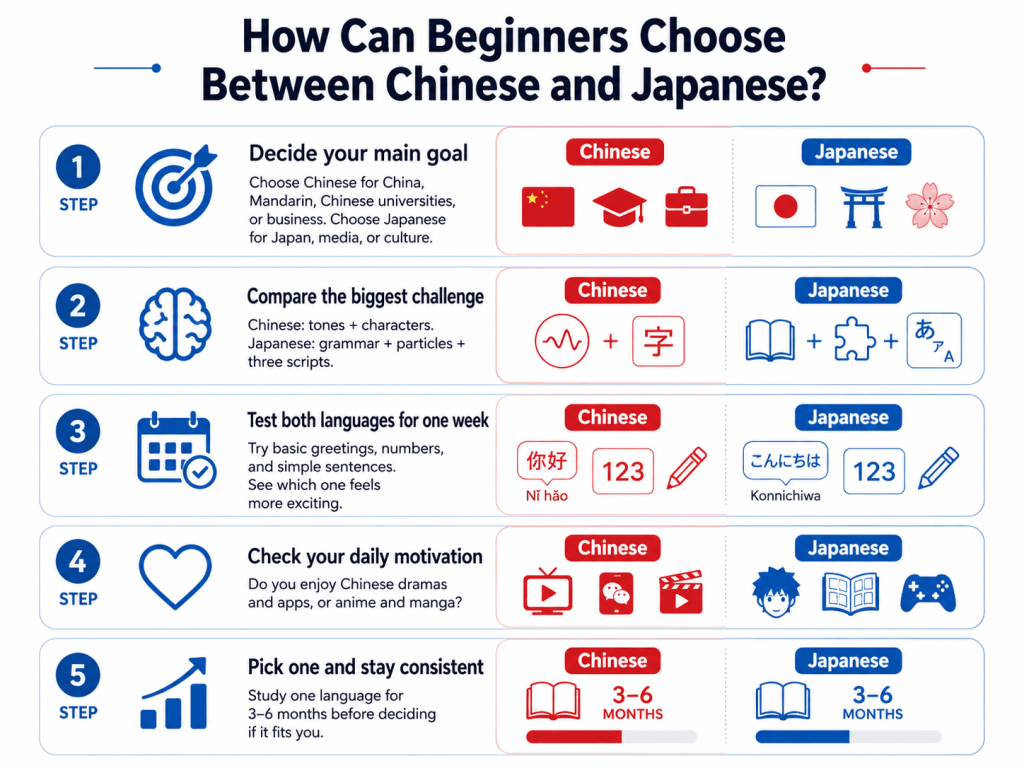
Step 1: Decide your main goal. Choose Chinese if your goal is China, Mandarin, Chinese universities, or Chinese business. Choose Japanese if your goal is Japan, Japanese media, or Japanese culture.
Step 2: Compare the biggest challenge. Choose Chinese if you are ready to practice tones and Chinese characters. Choose Japanese if you are ready to learn grammar, particles, and three scripts in one writing system.
Step 3: Test both languages for one week. Try basic greetings, numbers, and simple sentences in both languages. See which one feels more exciting.
Step 4: Check your daily motivation. Ask yourself which content you naturally enjoy more. Do you watch Chinese dramas, use Chinese apps, and want to learn Chinese? Or do you watch anime, read manga, and want to visit Japan?
Step 5: Pick one and stay consistent. Do not switch too often. Study one language for at least three to six months before deciding if it fits you.
Why is learning Chinese useful for students?
Learning Chinese is useful if you want to study, travel, or work in China.
China has many universities, cities, industries, and cultural traditions. Mandarin can help international students communicate in daily life, join campus activities, and understand local customs.
Even basic Chinese can help with:
- ordering food
- using transport apps
- asking for directions
- shopping
- making friends
- understanding campus notices
- joining university life
If you plan to study in China, learning Chinese can make your experience smoother and more meaningful.
You do not need perfect Chinese before arriving. But if you learn Chinese basics early, you will feel more confident in your first weeks.
Final answer: Chinese language vs Japanese language
Chinese and Japanese look similar because of shared Chinese characters, but they are very different languages.
| Aspects | Chinese | Japanese |
| Overall Difficulty | Hard at the beginning (tones, pronunciation) | Harder later (grammar, writing complexity) |
| Speaking Style | More direct and straightforward | More indirect and polite |
| Writing Complexity | Many characters to memorize | Mix of kanji, hiragana, and katakana |
| Learning Curve | Steep start, smoother progress later | Easier start, more complex as you advance |
| Vocabulary Origin | Native Chinese words | Mix of native words and borrowed Chinese characters |
| Cultural Expression | Focus on clarity and efficiency | Focus on politeness and social harmony |
| Best For | Study, business, and communication in China | Culture, media, travel, and life in Japan |
Related Articles
Read more from Apply For China:
- Study Chinese Language in China
- Best Apps and Websites to Learn Chinese Online
- How Many Languages Are Spoken in China?
- Study Abroad in China: 2026 Guide for International Students
- Top Universities in China 2026: QS, THE & ARWU Rankings
- Top 10 Most Prestigious Universities in China 2026
- Best Universities in China: Guide for International Students
Frequently Asked Questions
No. Chinese and Japanese are different languages. They share some Chinese characters, but their pronunciation, grammar, and sentence structure are very different.
Chinese is often harder for pronunciation because Mandarin uses tones. Japanese is often harder for grammar and writing because it uses kanji, hiragana, and katakana together.
Chinese speakers may understand some kanji meanings in Japanese. But they usually cannot fully read Japanese because Japanese uses different grammar, hiragana, katakana, and different readings.
Japanese speakers may recognize some Chinese characters. But they usually cannot understand full Chinese sentences without studying Chinese grammar, tones, and vocabulary.
Learn Chinese first if you want to study in China, work with Chinese companies, or use Mandarin in daily life. Learn Japanese first if you love Japanese culture, anime, manga, travel, or want to work with Japan.
Start Your Journey to Study in China Today
Choosing to study in China is a life-changing decision that opens the door to world-class education, cultural diversity, and exciting global opportunities. Whether you’re researching top China universities or preparing your China university application, having a trusted partner can make all the difference.
At ApplyForChina, we make the process simple and stress-free. From finding the right university to submitting your application, we’re here to support you every step of the way.