
Funny & Festive Chinese Idioms You Need to Know
Idioms are unique in each language, and in Chinese, they come with a whole side of history, legends, and deep meaning behind them. Additionally, Chinese people frequently employ idioms in their daily lives, whether in drama, short videos, or posts on Weibo. Whether you’re just trying to impress your Chinese friends or want to understand what your favorite Chinese drama characters are yelling about, knowing a few idioms can go a long way.
Here’s a fun roundup of some memorable and culturally rich Chinese idioms you’ll love—including ones with tigers, moon goddesses, and Chinese New Year energy.
- What is Chinese Idiom——成语 (chéngyǔ)
- 1. 嫦娥奔月 (Cháng É bēn yuè) — Chang'e Flies to the Moon
- 2. 虎头蛇尾 (hǔ tóu shé wěi) — Tiger's Head, Snake's Tail
- 3. 对牛弹琴 (duì niú tán qín) — Playing the Lute to a Cow
- 4. 除旧迎新 (chú jiù yíng xīn) — Out with the Old, In with the New
- 5. 拿手好戏 (ná shǒu hǎo xì) — Signature Move
- 6. 心甘情愿 (xīn gān qíng yuàn) — Willingly and Happily
- 7. 掩耳盗铃 (yǎn ěr dào líng) — Covering One's Ears While Stealing a Bell
- 8. 画蛇添足 (Huà shé tiān zú) — Drawing Legs on a Snake
- 9. 盲人摸象 (Máng rén mō xiàng) — Blind Men Touching an Elephant
- 10. 守株待兔 (Shǒu zhū dài tù) — Waiting by a Tree for a Hare
- Idioms, Stories, or History?
- Start Your Journey to Study in China Today
What is Chinese Idiom——成语 (chéngyǔ)
A Chinese idiom, or 成语 (chéngyǔ), is a type of traditional expression in Chinese, usually made up of four characters. These idioms often originate from classical literature, historical, or ancient philosophy, and they convey figurative meanings that extend beyond their literal interpretation. Moreover, idioms are concise, vivid, and culturally rich, making them an essential part of the Chinese language.
Key Features of 成语 Chengyu:
- Four-Character Structure: Most Chinese Idioms have four Chinese characters, making them concise and rhythmic.
- Fixed Structure: They are set phrases, so you usually can’t change the word order or swap out characters.
- Rich Cultural Context: Many idioms are tied to specific stories, historical events, or moral lessons. Some of them come from ancient texts like “论语 Lun yu” The Analects of Confucius, “史记 Li Ji” Records of the Grand Historian, etc, which is why knowing the backstory often helps in understanding the true meaning.
- Figurative Meaning: The meaning is often metaphorical, and the literal translation may not convey the actual significance. Therefore, simply translating the words may not be sufficient. To truly grasp the meaning, it is important to look for contextual clues or understand the background story.
1. 嫦娥奔月 (Cháng É bēn yuè) — Chang’e Flies to the Moon
Let’s kick things off with one of the most poetic idioms out there. This phrase comes from one of China’s most famous legends.
Back in ancient times, there were ten suns scorching the Earth. The hero Hou Yi shot down nine of them with his magical bow, leaving just one to light the world. As a reward, he was given a potion of immortality. Not wanting to live forever without his beloved wife Chang’e, he gave her the potion to keep safe.

One day, one of his apprentices got greedy and tried to steal it while his master, Hou Yi was away. Being all alone and unable to outfight him, Chang’e swallowed the potion herself to prevent disaster. She then floated up to the moon, where she remains to this day. After learning this, Hou Yi felt heartbroken; he looked up and saw her shadow on the moon. After that, he laid out her favorite food as an offering, which is the moon cake. Legend has it that this is how the Mid-Autumn Festival originated.
So, what does this idiom mean in daily use? It usually refers to something beautiful or unattainable—or more figuratively, someone escaping to a distant, unreachable place. A touch of a tragic romance.
Example:
她的梦想就像嫦娥奔月,美丽却遥不可及。
tā de mèngxiǎng jiù xiàng cháng é bēn yuè , měilì què yáo bù kějí .
Her dream is like Chang’e flying to the moon—beautiful but unreachable.

2. 虎头蛇尾 (hǔ tóu shé wěi) — Tiger’s Head, Snake’s Tail
You start strong but end with a fizzle. That’s what this idiom means. Imagine beginning a project with the energy of a tiger—ferocious and bold—but ending it weakly, like a slithering snake.

This idiom comes from observations in traditional Chinese storytelling and performance, where some stories or acts would begin with intense drama and look promising but end without resolution or flair, such a disappointing ending. It’s a visual metaphor that’s easy to grasp: a mighty start (tiger’s head) followed by a disappointing, flimsy finish (snake’s tail).
After learning this idiom, you can use it to describe your friend who got super hyped about a gym membership in January but went MIA by March. A classic case of tiger head, snake tail.
Example:
这个项目开始时很有激情,可惜虎头蛇尾,最后草草收场。
zhègè xiàngmù kāishǐ shí hěn yǒu jīqíng , kěxī hǔ tóu shé wěi , zuìhòu cǎocao shōu chǎng
This project started with great passion, but unfortunately, it was a “tiger’s head, snake’s tail,” ending hastily.
3. 对牛弹琴 (duì niú tán qín) — Playing the Lute to a Cow
Ever tried explaining memes or jokes to your grandma or teaching your dog how to shake hands and roll? That’s the vibe here.
This idiom originates from a story about a philosopher named Gong Mingyi, who loved playing the qin (Chinese traditional stringed instrument). He once played a beautiful melody for a cow, but of course, the cow just stood there, chewing grass. The cow had no appreciation or understanding of the art being presented.
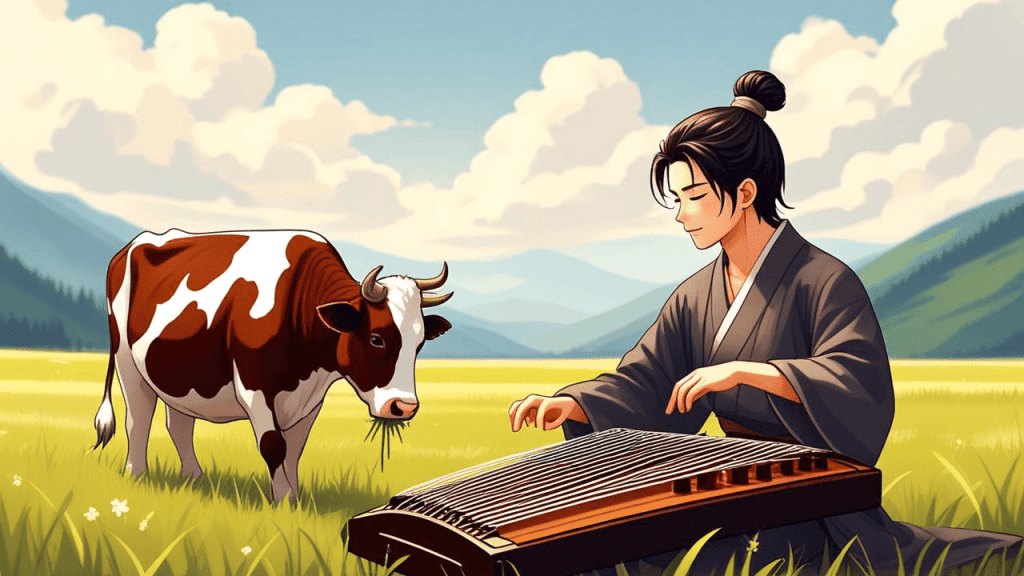
This idiom mocks situations where you’re offering wisdom, art, or deep thoughts to someone who just doesn’t get it—and probably never will. Somehow, this idiom is a little bit similar to the English idiom “goes in one ear and out the other.” In short, save your energy, the cow’s not into classical music.
Example:
跟他讲道理简直是对牛弹琴,他根本听不进去。
gēn tā jiǎngdàolǐ jiǎnzhí shì duì niú tán qín , tā gēnběn tīng bù jìnqù
Reasoning with him is like playing the lute to a cow—he won’t listen.
4. 除旧迎新 (chú jiù yíng xīn) — Out with the Old, In with the New
This idiom embodies transformation, it means letting go of regrets, ditching outdated routines, and embracing what’s ahead. Whether you’re getting into a new relationship or starting a new job, this idiom fits.
This idiom means a lot during Chinese New Year. Because the traditional Chinese custom for welcoming the Chinese New Year literally is to clean out the house to sweep away bad luck and misfortune from this year, and make space for a fresh, lucky new year. But it can also be about mindset and writing them as your new year’s resolution.

You’ll hear this idiom a lot during Chinese New Year, also known as Spring Festival, when families clean their homes inside-out, hang red couplets filled with festives, and cook up feasts to reset the energy for a new year. Therefore, this one is definitely one of the Chinese idioms you need to know!
Example:
春节时,人们打扫房子、买新衣服,寓意除旧迎新。
chūn jié shí , rén men dǎ sǎo fáng zi , mǎi xīn yīfú , yùyì chú jiù yíng xīn
During Chinese New Year, people clean their houses and buy new clothes, symbolizing “discarding the old (year) and welcoming the new (year)”.
5. 拿手好戏 (ná shǒu hǎo xì) — Signature Move
Literally translated as “best act of the hand,” this idiom is not that hard to comprehend, it refers to someone’s specialty or best skill.
This idiom comes from traditional Chinese opera, where actors often had a particular role or performance—known as their “拿手好戏”—that wowed audiences every time. It was the highlight of their repertoire, the act they perfected through repetition and talent.
These days, it can describe anything from your friend’s unbeatable hotpot recipe to your killer karaoke performance. When someone says, “That’s your 拿手好戏,” they mean you’re crushing it at something you’re known for doing well.
Example:
做川菜是她的拿手好戏,每次聚餐大家都赞不绝口。
zuò chuāncài shì tā de ná shǒu hǎo xì , měicì jùcān dàjiā dōu zàn bù jué kǒu
Making Sichuan cuisine is her specialty—everyone praises it at gatherings.

6. 心甘情愿 (xīn gān qíng yuàn) — Willingly and Happily
This Chinese idiom is all about doing something because you truly want to, no complaints.
The phrase is composed of four characters: 心 (heart), 甘 (willing), 情 (emotion), and 愿 (desire). Together, they express a complete, voluntary, and emotional commitment to an action.
The idiom traces back to expressions in ancient texts where devotion, whether in love, family, or sacrifice, was seen as noble and praiseworthy. It often appeared in poetry or stories where a character would give up something important not out of obligation but out of deep affection or belief.
You volunteered to help your friend move house in August heat? 心甘情愿. You stayed up all night baking cakes for your family? 心甘情愿.
It’s used to describe a pure, no-regrets kind of devotion or sacrifice. One of those idioms that’s as wholesome as it sounds.
Example:
为了孩子的未来,父母心甘情愿付出一切。
wèile háizi de wèilái , fùmǔ xīn gān qíng yuàn fùchū yiqiè .
For their child’s future, parents are willing to sacrifice everything gladly.

7. 掩耳盗铃 (yǎn ěr dào líng) — Covering One’s Ears While Stealing a Bell
This idiom comes from a classic Chinese fable, a hilarious one at that. A thief once tried to steal a bell from someone’s house but realized it made too much noise. His brilliant idea? Cover his own ears so he wouldn’t hear it. He figured if he couldn’t hear the bell, neither could anyone else. But the reality was, of course, everyone did hear, and he got caught.
The idiom is now used to mock self-deception or deluding oneself, when people ignore reality, thinking their denial will somehow change the truth. It’s a reminder that pretending something isn’t happening doesn’t make it go away. This idiom is one of a great sentence for those moments when someone is clearly avoiding the obvious.
Example:
他以为删掉聊天记录就没人知道,真是掩耳盗铃。
tā yǐwéi shāndiào liáotiān jìlù jiù méi rén zhīdào , zhēnshì yǎn ěr dào líng
He thought deleting the chat history would hide the truth—what a self-deception!

8. 画蛇添足 (Huà shé tiān zú) — Drawing Legs on a Snake
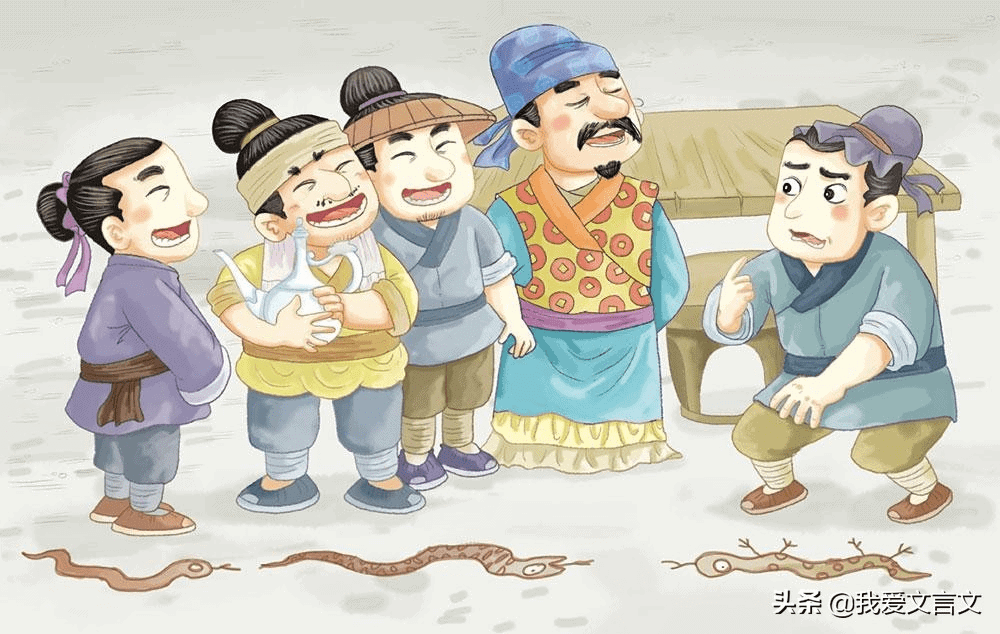
Just reading the literal translation of this Chinese idiom in the title will let you know how funny this one is. The background story of this idiom is during the Warring States period (战国 ), a wealthy man rewarded his servants with a pot of wine. Since there wasn’t enough for everyone, they decided to hold a contest, and whoever could draw a snake the fastest would win the wine.
One servant finished drawing his snake in seconds and, feeling proud, thought, “I can make this even better!” So he added legs to his snake. Meanwhile, another servant completed his drawing and managed to win the wine, while saying, “Snakes don’t have legs—you ruined it!”
The meaning behind this idiom is to satirize people who overcomplicate things or ruin a good thing by adding unnecessary extras. It’s the Chinese equivalent of “gilding the lily.”
Example:
这篇报告本来很好,但你加了太多无关数据,简直是画蛇添足!
zhèpiān bàogào běnlái hěnhǎo, dàn nǐ jiā le tàiduō wúguān shùjù, jiǎnzhí shì huà shé tiān zú !
This report was great, but you added too much irrelevant data—totally superfluous (drawing legs on a snake)!
9. 盲人摸象 (Máng rén mō xiàng) — Blind Men Touching an Elephant
I personally really like this one. This idiom comes from an ancient Buddhist parable. One day, a wise Emperor ordered several blind men to touch an elephant for the first time and try to describe it based on the part they touched:
One felt the leg and said, “An elephant is like a tree!”
Another touched the tail and declared, “No, it’s like a rope!”
The third man held his trunk and argued, “You’re both wrong. It’s like a snake!”
The last man touched the body and exclaimed, “No, you’re all wrong. It’s like a wall!”
Since none of them could see the whole elephant, and the elephant was too large, they argued endlessly, each convinced they were right without checking out the whole elephant.
What this idiom describes is how people who only see part of the truth but assume they understand everything, leading to narrow-minded, useless arguments.
Example:
你们只看到问题的一小部分就争吵,简直是盲人摸象!
nǐmen zhǐ kàndào wèntí de yī xiǎo bùfèn jiù zhēngchǎo , jiǎn zhí shì máng rén mō xiàng
You’re arguing over just one small part of the problem—this is like “blind men touching an elephant“!

10. 守株待兔 (Shǒu zhū dài tù) — Waiting by a Tree for a Hare
You might wonder, ‘What’s this hare doing?’ Exactly! Now, let’s understand this idiom by understanding the whole background story.
This tale comes from Han Feizi, a Legalist philosopher. The story was about a farmer who once saw a rabbit sprint headfirst into a tree stump and die unexpectedly! After seeing this, he had a thought, ‘What a bargain!’ After that, instead of working, he abandoned his fields and camped by the stump every day, waiting for another rabbit to knock itself out. The result? Of course, no more rabbits came, his crops failed from being abandoned, and he became the laughingstock of the village.

What this idiom teaches us is that you cannot rely just on luck instead of hard work, and expect success without effort. In the end, your efforts matter, and laziness will grant you nothing. So, work hard!
Example:
你天天买彩票想发财?别守株待兔了,去找个工作吧!
nǐ tiāntian mǎi cǎipiào xiǎng fācái ? bié shǒu zhū dài tù le , qù zhǎo gè gōngzuò ba !
You buy lottery tickets every day, hoping to get rich? Stop day-dreaming (waiting by a tree for a hare) and get a job!

Idioms, Stories, or History?
So, what exactly is Chinese Idioms? To sum it up, Chinese idioms are mini-stories packed with emotion, history, and humor. They don’t just color the language—they tell you how Chinese people think, what they value, and how they celebrate life. From a great hero who shoots suns to a thief fooling himself, these phrases add a rich, cultural punch to everyday conversations.
So next time you’re cleaning your house before the New Year or watching the moon on Mid-Autumn night, remember: there’s probably an idiom for that—and now, you know it.
Start Your Journey to Study in China Today
Choosing to study in China is a life-changing decision that opens the door to world-class education, cultural diversity, and exciting global opportunities. Whether you’re researching top China universities or preparing your China university application, having a trusted partner can make all the difference.
At ApplyForChina, we make the process simple and stress-free. From finding the right university to submitting your application, we’re here to support you every step of the way.